

Qualcomm and MediaTek have introduced their latest flagship smartphone chipsets, bringing major upgrades in performance, efficiency, artificial intelligence, graphics, cameras, and connectivity. This vs article contains all the necessary information that one needs to know when selecting a chipset between the Snapdragon 8 Elite Extreme Gen 6 and Dimensity 9600 Pro.
The Snapdragon 8 Elite Extreme Gen 6 and MediaTek Dimensity 9600 Pro are both built using TSMC’s advanced 2nm N2P process. The move from the 3nm generation to 2nm is one of the biggest changes in these new processors and is expected to improve both performance and power efficiency.
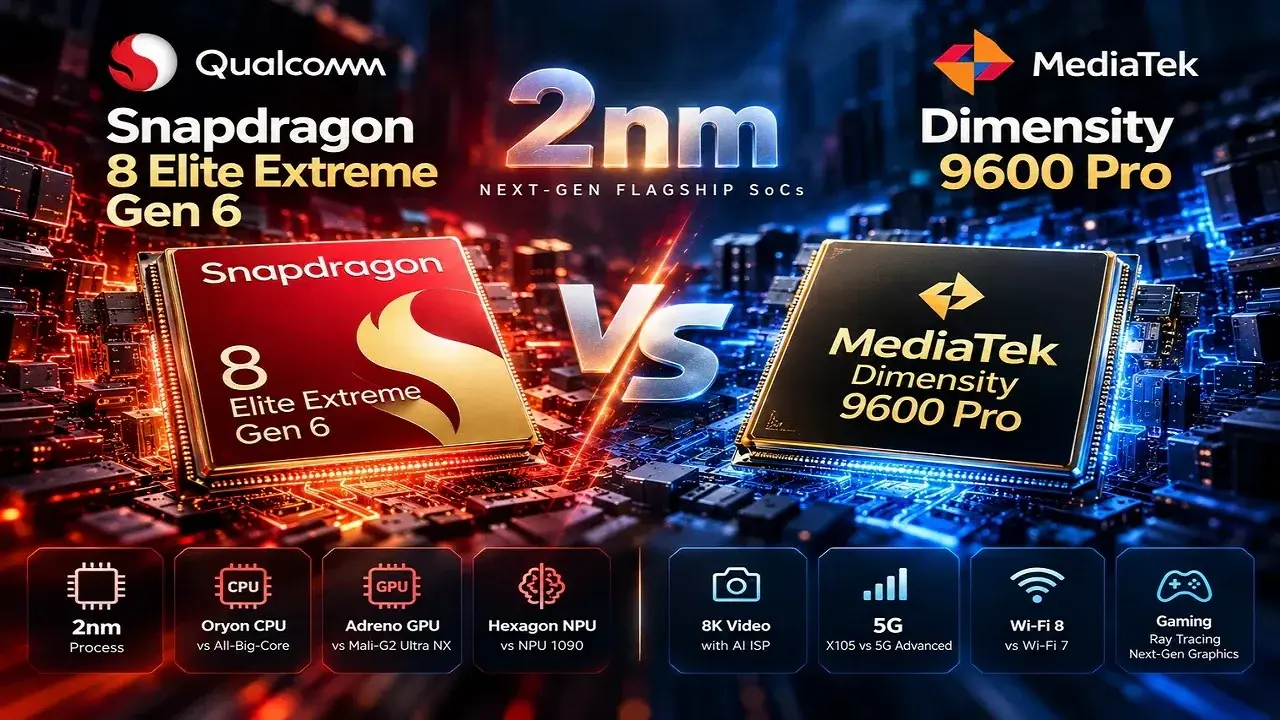
Despite targeting the same flagship smartphone segment, Qualcomm and MediaTek have taken different approaches to CPU, GPU, and AI processing. Early benchmark results show that the Snapdragon chip has an advantage in single-core performance and overall AnTuTu scores, while the Dimensity 9600 Pro performs slightly better in multi-core testing and GPU performance.
Snapdragon 8 Elite Extreme Gen 6 vs Dimensity 9600 Pro Specs
Both chipsets feature eight-core CPU designs, but their architectures and clock speeds are different.
The Snapdragon 8 Elite Extreme Gen 6 uses two prime cores clocked at up to 5.0GHz and six performance cores running at up to 4.0GHz. It supports LPDDR5X and LPDDR6 memory at speeds of up to 5,300MHz, along with UFS 4.1 and UFS 5.0 storage.
The Dimensity 9600 Pro uses a 2+3+3 CPU configuration. It has two C2-Ultra cores running at up to 4.55GHz, three C2-Pro cores at up to 4.35GHz, and another three C2-Pro cores clocked at up to 3.1GHz. It supports LPDDR6 memory at up to 5,333MHz and also supports UFS 4.1 and UFS 5.0 storage.
For graphics, Qualcomm uses the Adreno 850 GPU with dedicated AI matrix cores, Adreno Neural Fusion, and 18MB of Adreno HPM. MediaTek relies on the Mali-G2 Ultra NX MP12 GPU and an AI-assisted neural upscaling engine.
The Snapdragon chipset also includes Qualcomm’s Hexagon NPU, dual Micro NPUs, and dual always-sensing ISPs. The Dimensity 9600 Pro features a dual-NPU architecture with MediaTek’s NPU 1090 and Super Efficient NPU 2.0, supporting up to 30 billion parameters.
Benchmark Performance
Early benchmark results provide an interesting comparison between the two flagship processors. The tests were conducted using the Xiaomi 18 Pro Max with the Snapdragon 8 Elite Extreme Gen 6 and the Vivo X500 Pro Max with the Dimensity 9600 Pro.
Geekbench 7
The Snapdragon chipset takes a clear lead in single-core performance.
The Snapdragon 8 Elite Extreme Gen 6 scored 3,163 points in the Geekbench 7 single-core test, compared with 2,600 points for the Dimensity 9600 Pro. This gives Qualcomm’s chipset an advantage of around 21%.
However, the situation changes in the multi-core test. The Dimensity 9600 Pro scored 10,634 points, while the Snapdragon 8 Elite Extreme Gen 6 recorded 10,172 points.
This gives MediaTek a roughly 4% advantage in multi-core performance. The difference is relatively small, meaning both processors should offer strong performance for demanding applications and multitasking.
| Benchmark | Snapdragon 8 Elite Extreme Gen 6 | Dimensity 9600 Pro |
|---|---|---|
| Geekbench 7 Single-Core | 3,163 | 2,600 |
| Geekbench 7 Multi-Core | 10,172 | 10,634 |
AnTuTu
The Snapdragon 8 Elite Extreme Gen 6 performs better in the overall AnTuTu test.
Qualcomm’s chipset achieved 4,592,331 points, while the Dimensity 9600 Pro scored 4,324,196 points. This gives Snapdragon an overall lead of around 6%.
The detailed results show that the Snapdragon chip also leads in CPU, memory, and UX performance. However, the Dimensity 9600 Pro performs better in the GPU portion of the test.
| AnTuTu Test | Snapdragon 8 Elite Extreme Gen 6 | Dimensity 9600 Pro |
|---|---|---|
| Overall | 4,592,331 | 4,324,196 |
| CPU | 1,226,866 | 1,138,784 |
| GPU | 1,762,900 | 1,858,369 |
| Memory | 627,667 | 494,845 |
| UX | 974,898 | 832,198 |
The numbers show that neither chipset dominates every category. Snapdragon has a stronger overall result, while MediaTek has an edge in GPU testing.
Major CPU Efficiency Improvements
The switch to the 2nm process is one of the biggest upgrades in both chipsets.
Qualcomm has pushed its flagship mobile processor to a 5GHz peak clock speed for the first time. The company claims a 37% improvement in power efficiency and a 13% increase in CPU performance.
The Snapdragon chip continues with a 2+6 CPU configuration, but its six performance cores can now reach up to 4.0GHz.
MediaTek has taken a different approach with the Dimensity 9600 Pro. It uses a 2+3+3 arrangement designed to increase peak performance. Its two C2-Ultra cores reach up to 4.55GHz, while three C2-Pro cores run at up to 4.35GHz.
MediaTek claims a 17% increase in single-core performance and a 15% improvement in multi-core performance. It also claims major efficiency improvements, including up to 37% better single-core power efficiency and a 61% improvement in multi-core power efficiency.
Qualcomm Brings AI Processing Directly to the GPU
One of the most important changes in the Snapdragon 8 Elite Extreme Gen 6 is the integration of dedicated AI processing blocks directly into the GPU.
On previous-generation Snapdragon chips, some AI workloads had to move between the Adreno GPU and Hexagon NPU. Qualcomm’s new architecture allows certain AI workloads to be processed directly inside the Adreno 850 GPU.
This approach is designed to reduce processing latency and improve real-time neural rendering. Qualcomm claims a 44% improvement in GPU performance and a 40% increase in GPU power efficiency.
MediaTek has taken a different route with the Dimensity 9600 Pro. Instead of placing dedicated AI blocks directly into the GPU, the company has improved communication between the CPU, GPU, NPU, and ISP.
The NPU 1090 acts as a centralized AI processing hub, providing AI assistance to different parts of the chipset.
MediaTek claims up to 27% higher peak performance and 24% better power efficiency at peak performance. The company also claims an 18% improvement in ray-tracing performance and support for gaming at more than 185 frames per second.
Camera and Video Improvements
Both processors bring major improvements to smartphone photography and video recording.
The Snapdragon 8 Elite Extreme Gen 6 features Qualcomm’s Spectra Triple AI-ISP with a 20-bit architecture. It supports cameras with resolutions of up to 320MP and can handle three 64MP cameras simultaneously with zero shutter lag.
The chipset supports 8K video recording at 60fps and 4K slow-motion recording at 240fps. It also adds hardware acceleration for Qualcomm’s Advanced Professional Video codec.
The Dimensity 9600 Pro uses MediaTek’s Imagiq 1290 ISP and supports cameras with resolutions of up to 200MP. It can also record 8K video at 60fps and 4K slow-motion video at 240fps.
MediaTek additionally highlights a 17-stop exposure range, along with support for 4K/60fps HDR recording and 4K/120fps recording with electronic image stabilization.
Connectivity
Qualcomm also has an advantage in connectivity specifications.
The Snapdragon 8 Elite Extreme Gen 6 includes the Snapdragon X105 5G modem, offering peak download speeds of up to 14.8Gbps and upload speeds of up to 4.2Gbps. It also supports Wi-Fi 8 with peak speeds of up to 11.6Gbps and Bluetooth 6.0.
The Dimensity 9600 Pro uses a 3GPP Release-17 5G modem with download speeds exceeding 7.4Gbps. It supports Wi-Fi 7 with peak speeds of up to 7.3Gbps and Bluetooth 6.2.
Which Chipset Is More Powerful?
The early benchmark results suggest that the Snapdragon 8 Elite Extreme Gen 6 has a small overall advantage, particularly in single-core CPU performance and the overall AnTuTu score.
The Dimensity 9600 Pro, however, should not be overlooked. It delivers slightly better multi-core performance and a higher AnTuTu GPU score. Its new CPU configuration and AI architecture also bring significant improvements in efficiency and performance.
In practical use, both chipsets should provide flagship-level performance for gaming, photography, video recording, multitasking, and AI applications. The final experience will also depend on smartphone cooling systems, software optimization, battery capacity, and other hardware.
The first smartphones featuring these 2nm processors, including the Xiaomi 18 Pro Max and Vivo X500 Pro Max, are currently limited to the Chinese market. More devices powered by these chipsets are expected to reach international markets, with a much wider range of 2nm flagship smartphones likely to appear over the coming year.
Tinggalkan komentar
Alamat email Anda tidak akan dipublikasikan. Kolom yang wajib diisi ditandai *