

T-Mobile Dominates 5G Standalone Access as AT&T and Verizon Trail Behind
The race for faster and more advanced 5G networks in the United States is taking another turn, with T-Mobile maintaining a significant lead in 5G Standalone (5G SA) availability.
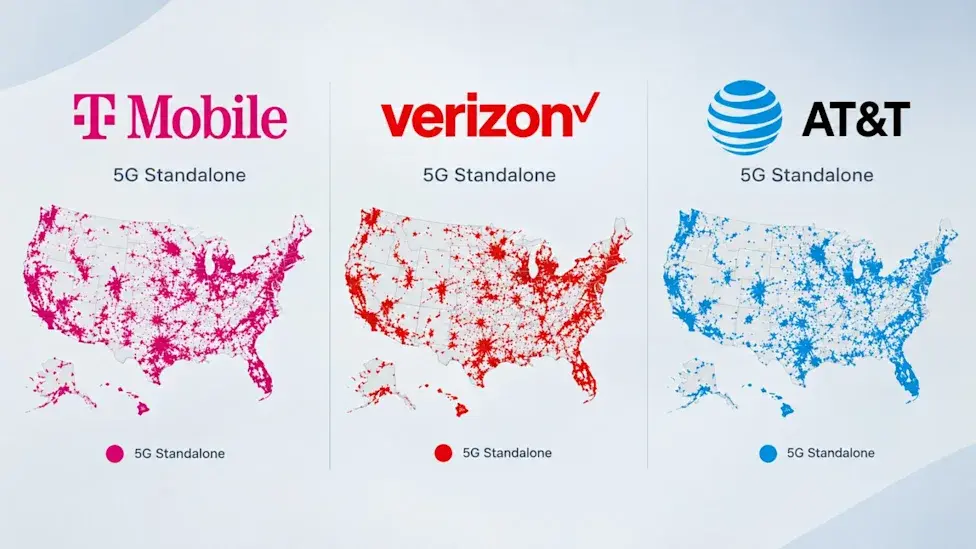
New data from Opensignal shows that T-Mobile customers were connected to a 5G Standalone network 71.2% of the time during the measurement period. Verizon followed at 20.2%, while AT&T customers had access to 5G SA just 4.4% of the time.
The figures highlight an important distinction between the 5G icon displayed on a smartphone and actually using a complete 5G Standalone network.
What Is 5G Standalone?
5G Standalone, commonly called 5G SA, is a version of 5G that uses a dedicated 5G core network instead of relying on a 4G LTE core.
Earlier 5G deployments often used a technology called 5G Non-Standalone (5G NSA). With NSA, the phone connects to 5G radio technology while still relying partly on existing 4G infrastructure.
5G SA is designed to provide a more advanced network architecture that can support lower latency, improved network capabilities and technologies such as network slicing.
This makes 5G SA an important foundation for future services involving AI, connected devices, industrial applications, real-time communications and other demanding workloads.
T-Mobile Has a Huge Lead in 5G SA Access
According to the latest Opensignal data, T-Mobile customers had access to 5G Standalone 71.2% of the time.
Verizon was significantly lower at 20.2%, while AT&T recorded just 4.4%.
That means T-Mobile customers were connected to 5G SA more than three times as often as Verizon users and dramatically more often than AT&T customers.
The numbers are particularly notable because all three major U.S. carriers now have nationwide 5G Standalone networks.
However, having a nationwide network does not necessarily mean customers spend most of their time connected to it.
A 5G Icon Doesn't Always Mean 5G Standalone
One of the biggest takeaways from the report is that seeing “5G” at the top of a smartphone screen does not necessarily mean the device is connected to 5G Standalone.
A phone can use 5G NSA, which combines a 5G radio network with a 4G LTE core.
5G SA uses 5G technology throughout the network architecture, potentially enabling capabilities that aren't available in the same way through older NSA deployments.
This difference is becoming increasingly important as carriers move toward more advanced 5G services.
AT&T Leads in 5G SA Download Speeds
T-Mobile's advantage is not universal across every measurement.
Interestingly, AT&T recorded the fastest 5G Standalone download and upload speeds in the Opensignal comparison.
AT&T reached approximately 344.7 Mbps download and 22.6 Mbps upload on 5G SA.
T-Mobile and Verizon recorded lower speeds in the same measurement.
However, the report points out that AT&T's relatively limited 5G SA user base may contribute to its higher speeds because the network is handling less traffic.
This demonstrates why network performance cannot be judged using speed alone.
T-Mobile Leads in 5G SA Latency
T-Mobile also performed strongly in latency.
The carrier recorded approximately 40.2 milliseconds of latency on 5G Standalone.
AT&T followed closely at 40.6 milliseconds, while Verizon recorded 42.9 milliseconds.
Lower latency means less delay between sending information and receiving a response.
That can benefit applications such as online gaming, video calls, cloud computing, remote control systems and other real-time services.
AT&T Performs Well in Consistent Quality
While T-Mobile has a huge advantage in 5G SA availability, AT&T performs strongly in another important category.
Opensignal's Consistent Quality measurement evaluates how reliably a network supports everyday activities and applications.
AT&T recorded 88.9%, compared with 86.4% for Verizon and 85.1% for T-Mobile.
This shows why consumers should look beyond a single network metric when comparing mobile carriers.
A network can have widespread 5G SA availability while another network may perform better in a particular quality or speed measurement.
T-Mobile's Early 5G SA Investment Is Paying Off
T-Mobile's current lead is closely connected to its early investment in 5G Standalone.
The carrier began deploying 5G SA to customers years before its competitors and eventually moved to nationwide availability.
T-Mobile launched its nationwide 5G SA network in April 2025, while AT&T and Verizon reached nationwide 5G SA milestones later.
That head start has given T-Mobile more time to expand compatible infrastructure and move customers onto its standalone network.
Why 5G Standalone Matters
5G SA is more than a technology upgrade designed simply to increase download speeds.
The architecture can support advanced capabilities including:
- Lower network latency
- Network slicing
- Advanced IoT applications
- Industrial automation
- Real-time communications
- Private enterprise networks
- Connected vehicles
- Advanced cloud applications
- Future 5G Advanced services
T-Mobile has already highlighted its standalone network as an important foundation for services such as T-Priority, which provides dedicated network priority capabilities for first responders.
5G SA Can Improve More Than Speed
The benefits of standalone 5G aren't limited to peak download speeds.
Research using Opensignal data has shown that 5G SA can reduce latency and improve file download performance compared with 5G NSA.
For example, Ofcom's analysis found that downloads of several file sizes were substantially faster over 5G SA than 5G NSA in its 2025 measurements.
The technology therefore has the potential to improve the overall responsiveness and efficiency of mobile networks.
T-Mobile Is Also Expanding Advanced 5G Capabilities
T-Mobile's investment in standalone 5G is also providing a foundation for newer network technologies.
The company recently announced AI-powered network automation designed to help its network respond more quickly to changing conditions.
Its Self-Organizing Network technology can automatically adjust network resources, while new AI-powered capabilities are designed to improve resilience and network performance.
These developments show how 5G SA can become a foundation for more intelligent networks rather than simply another generation of wireless connectivity.
T-Mobile's 5G Advantage Is About Availability
The latest numbers don't necessarily mean T-Mobile wins every individual speed or quality test.
Instead, the biggest advantage is how often customers can actually access 5G Standalone.
A carrier may have extremely fast 5G SA speeds, but those speeds have less practical value if customers rarely connect to the standalone network.
T-Mobile's 71.2% availability gives its customers considerably more exposure to the newer network architecture than Verizon or AT&T users.
What This Means for Smartphone Users
For most consumers, the difference between 5G SA and 5G NSA may not always be obvious.
Web browsing, social media, video
Tinggalkan komentar
Alamat email Anda tidak akan dipublikasikan. Kolom yang wajib diisi ditandai *