

Inside Lenovo’s Mobile Technology Center Powering IMSA Racing
Motorsports depend on speed, precision and split-second decisions, but modern racing is powered by far more than engines and tires. Behind every IMSA race is a sophisticated mobile computing infrastructure that processes huge amounts of information in real time.
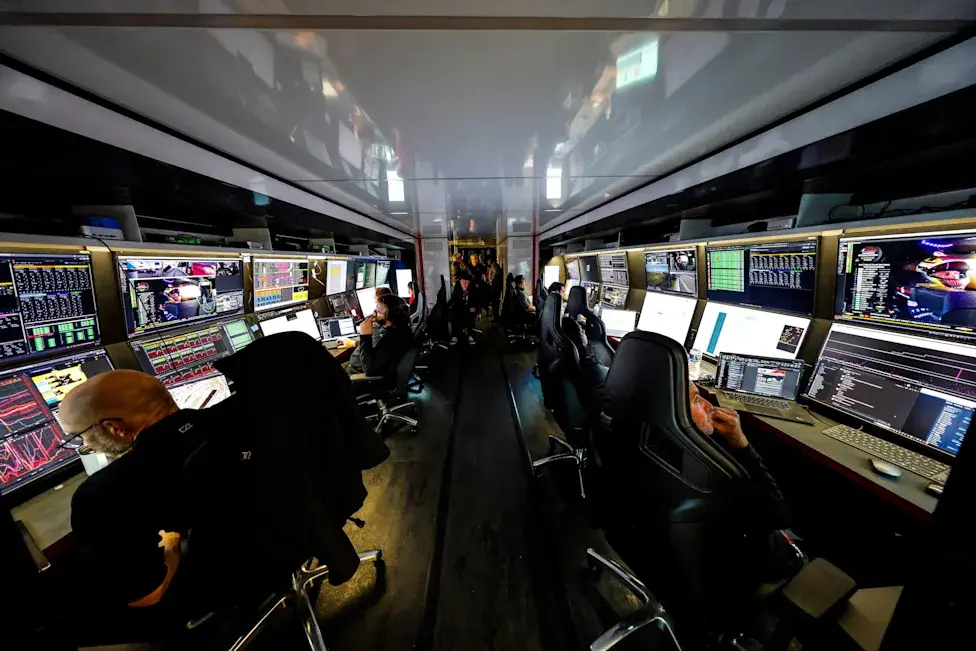
At the heart of that operation is the IMSA Lenovo Technology Center Powered by AMD, a custom-built mobile data center that travels from racetrack to racetrack throughout the racing season.
The technology center covers more than 20,000 miles every year, carrying the computing hardware needed for Race Control, timing, scoring, telemetry and other critical IMSA operations.
A Data Center That Travels With the Race
Traditional data centers remain in one location, but IMSA's technology infrastructure has to move constantly.
The Lenovo Technology Center is transported between circuits across the United States and must be ready to operate shortly after arriving at each venue. That creates a unique challenge: sensitive computing equipment has to survive thousands of miles of transportation before being deployed for another high-speed racing event.
Once the race begins, the workload becomes even more demanding.
The system processes more than 10,000 individual data points every second, providing officials with information that can influence decisions during a race.
Real-Time Race Data and Telemetry
Modern race cars generate enormous amounts of information.
IMSA uses the Lenovo and AMD-powered infrastructure to process vehicle telemetry alongside timing and scoring information. This allows race officials to monitor what is happening on the circuit almost instantly.
Telemetry can provide important information about a vehicle's performance and condition, while timing and scoring systems help officials track the position and progress of every competitor.
Processing this information close to the racetrack is critical because decisions cannot wait for data to travel to a distant data center.
Up to 72 Camera Feeds
The Lenovo Technology Center also supports an extensive video operation.
The infrastructure can handle up to 72 camera feeds, allowing Race Control to monitor multiple sections of a circuit simultaneously.
This can be particularly useful during incidents.
Instead of relying on a single camera angle, officials can examine different views of an accident, monitor pit-lane activity or continue following a vehicle after it moves away from the original incident location.
Combining video with telemetry, timing and scoring gives officials a much broader picture of what is happening on track.
Lenovo ThinkSystem and ThinkEdge Servers
Lenovo's ThinkSystem and ThinkEdge servers form the core of the mobile computing operation.
The infrastructure is powered by AMD EPYC processors, providing the processing capability needed for IMSA's demanding workloads. Lenovo laptops are also used within Race Control, giving officials access to the information generated by the mobile data center.
The system also incorporates redundancy.
Because a race cannot simply pause while a server is repaired, backup infrastructure is available to help keep critical operations running if the primary equipment encounters a problem.
Why Motorsports Are a Technology Test
For Lenovo, IMSA provides more than an opportunity to showcase hardware.
A racetrack is effectively a real-world stress test for computing technology. Data is constantly generated, decisions have to be made quickly and infrastructure needs to remain available throughout the event.
The environment closely resembles challenges faced in other industries where data must be processed near its source.
This is where edge computing becomes particularly important.
Instead of sending every piece of information to a remote cloud or centralized data center, edge computing allows data to be processed closer to where it is generated.
At a racetrack, that can mean faster access to telemetry, video and timing information.
What Fans See Is Only Part of the Story
Most viewers watching an IMSA race will never see the servers processing information behind the scenes.
They see cars competing for position, dramatic overtakes, pit stops and incidents.
But many of those visible moments depend on the technology operating in the background.
Race officials use live timing information to follow battles, telemetry to understand vehicle conditions and multiple camera feeds to investigate incidents.
The technology therefore becomes an invisible part of the racing experience.
The Challenge of Moving a Data Center
One of the most interesting aspects of IMSA's setup is its mobility.
The technology center has to be packed, transported and deployed repeatedly throughout the season. Unlike a conventional data center, its equipment cannot simply remain inside a purpose-built facility.
The infrastructure must be reliable enough to operate after being transported thousands of miles while still delivering the performance required for a live motorsports event.
That combination of mobility, computing power and reliability makes the IMSA Lenovo Technology Center a unique technology platform.
Lenovo and AMD Powering Modern Motorsport
The collaboration between Lenovo and AMD demonstrates how high-performance computing is becoming increasingly important outside traditional data-center environments.
AMD EPYC processors and Lenovo server platforms are being used to process the large volumes of information generated at IMSA events, while Lenovo's ThinkEdge technology supports computing closer to the action.
Lenovo describes innovation as a major part of its broader technology strategy, including work across edge computing, cloud, networking and artificial intelligence.
Final Thoughts
The next time you watch an IMSA race, remember that the action on the track is supported by a sophisticated computing operation traveling alongside the championship.
The IMSA Lenovo Technology Center Powered by AMD travels more than 20,000 miles each year, processes more than 10,000 data points per second and can support up to 72 video feeds.
From race control and telemetry to timing, scoring and incident analysis, the mobile data center plays a critical role in keeping modern motorsports running.
For Lenovo, IMSA also provides a valuable real-world environment for demonstrating how powerful edge computing can turn enormous amounts of live data into information that people can use immediately.
Leave a comment
Your email address will not be published. Required fields are marked *